Last month, I argued that when we think in Marxist terms about the contradictions of capitalism, the most striking and important contradiction of all is that by making goods buy and sell to keep the capitalist machine running, we are destroying the planet we depend on to survive.
It’s not just that we are using rare and non-renewable resources, that we are polluting our planet both large and small, it’s also that we seem, according to experts, to be generating climate changes that will have short, medium, and long-term implications on how and even where we can live. We can expect large waves of human migration in many parts of the world as many people leave places that have become uninhabitable in search of new homes. It can be argued that these migrations have already begun.
Schematic illustration of the interconnection of the themes of Chapter 4, including factors of sea level rise (SLR) and hazards (extremes) of sea level, exposure, vulnerability, impacts and risks related to SLR, as well as responses, challenges, and related governance practices and tools for making social choices and addressing governance challenges (Source: Special Report on the Ocean and Cryosphere in a Changing Climate, IPCC). Click to enlarge.
Given the disastrous consequences of climate change and the growing evidence presented by scientists studying climate trends, it is strange that so many people are willing to say they doubt science, that they distrust the motivations of climatologists, and that they simply do not face the problem. As Rex Murphy (or T-Rex Murphy, as Frank magazine amusingly and rightly calls him) said about a proposal from the Liberal government:
The Trudeau-McKenna church of the eco-evangelists has a plan to reduce Canada’s “carbon emissions,” as they call them… They are not imposing a price on pollution, by taxing all energy fuels. CO2 is not a pollutant — ask a factory. Ask a tree. Ask a human being during an exhalation. Sewage is a pollutant. It causes diseases. CO2 is a part of our planet’s atmosphere produced by nature, which gives life and enhances life.
I admit that I found it very easy to dismiss Rex Murphy and others in his camp, who make passionate arguments against all proposed measures to slow the pace of climate change, and who often express doubts about the validity of science and the motivations of those presenting it, like, indeed, ignorant dinosaurs: T-Rex seems an appropriate nickname indeed!
However, I recently attended a master’s thesis presented by one of my former students, a young woman named Caitlin Heppner. Caitlin’s defense was fascinating, and her arguments led me to rethink my instinctive response to so-called “climate change deniers” or “climate change skeptics,” and to think differently about how we might engage with them. Caitlin kindly shared her thesis with me and gave me permission to share her thoughts with the readers of the Cape Breton Spectator. In this month’s column, I want to explore the reasons for skepticism about climate change. (Next month, I will look at why many of us, even if we believe in science and trust scientists and their predictions, live as if we do not — and what we might do about it.)
As Caitlin is a philosopher, what interested her most were the epistemic challenges faced by those of us who are not climate scientists ourselves as we try to make sense of the information about climate change that these scientists present to us. She also explored the question of why those we might call “climate change deniers” or “climate change skeptics” are so reluctant to believe scientific evidence and so quick to question the motives of the scientists presenting it. While Caitlin (and I, and I’m sure most readers of this column) trust both the evidence and those who disseminate it, those who are not so convinced and not so confident have real reasons for skepticism about science and good reasons to distrust experts.
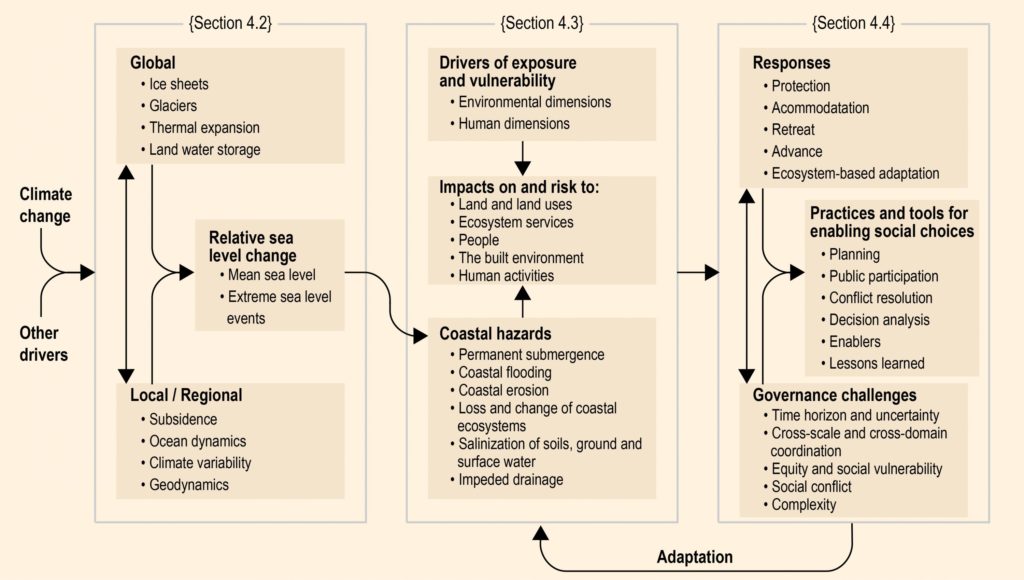
Schematic illustration of the interconnection of the themes of Chapter 4, including factors of sea level rise (SLR) and hazards (extremes) of sea level, exposure, vulnerability, impacts and risks related to SLR, and responses, challenges associated with governance and practices and tools for making social choices and addressing governance challenges (Source: Special Report on the Ocean and Cryosphere in a Changing Climate, IPCC). Click to enlarge.
By identifying these motives, Caitlin hopes (and I hope, as I quickly examine them in this column) that we might open new pathways for dialogue between “believers” and “skeptics”: T-Rex Murphy will probably never change his mind, but other climate change skeptics might, if we treat them not as fools, but as, at least in some cases, thoughtful individuals who have drawn different conclusions than we have. As Caitlin says:
There is something about the word denier that I’ve thought of as a militarized word. It’s contentious…
Instead, she prefers to use the term “skeptic.” Caitlin asserts that she believes climate change is happening:
… because I believe that scientists are telling me the truth and are capable of knowing it. That is, I believe their testimony.
And I would say the same is true for me: I have no way of doing the science myself, nor even of scientifically evaluating the claims that scientists present to me, so I have also chosen to trust their claims about what the evidence means and their motivations. In short, I too trust their testimony.
This is where we can begin to make sense of the positions of at least some of those who are skeptical about climate change: they doubt either the scientific claims, or the motivations of those making them, or both. They do not believe, that is, their testimony. And why not? While the motives for skepticism are varied, Caitlin identifies the following as central.
First,
some climate change skeptics distrust climate scientists and therefore doubt the claims they make: they point out that grant money and other funding could be a motivating factor in their most alarmist predictions. Second, most skeptics (like the rest of us) have no way of judging the science for themselves, and instead of choosing to trust the testimony of scientists as those of us who are not skeptical have chosen to do, they have instead chosen not to trust that testimony. Third, it is not always clear who counts as an expert, and, therefore, whose views should be trustworthy.
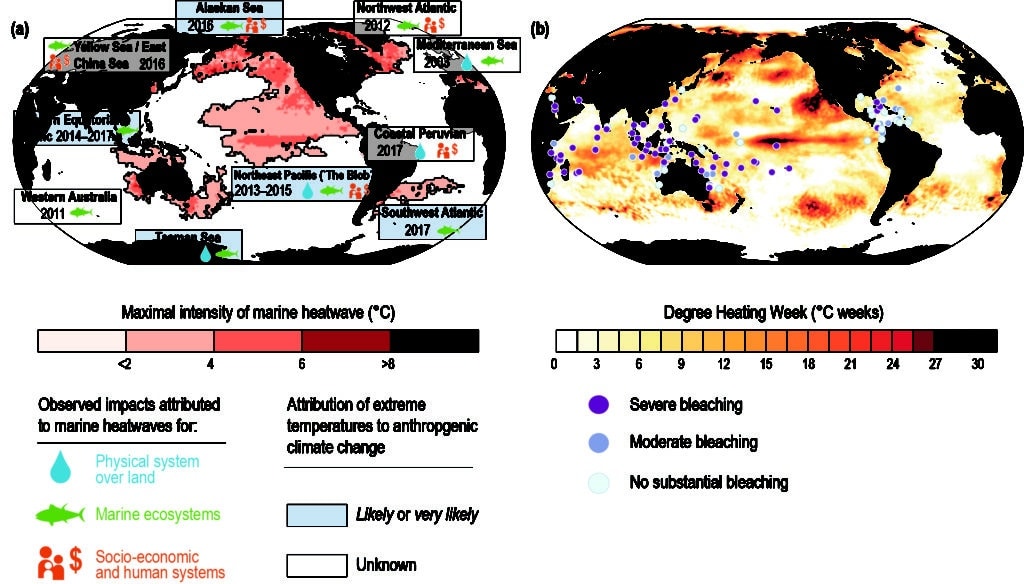
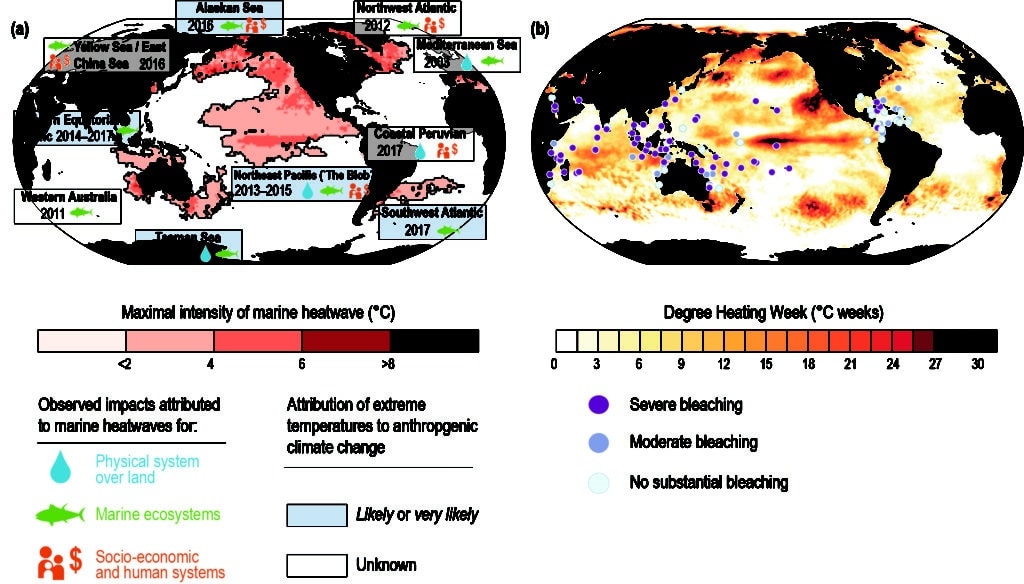
Examples of recent marine heat waves (MHW) and their observed impacts. a) Examples of documented MHW over the past two decades and their impacts on natural, physical, and socioeconomic systems. (Source: Special Report on the Ocean and Cryosphere in a Changing Climate, IPCC). Click to enlarge.
Finally, many skeptics dislike how science has been politicized, or how the divide between belief and skepticism has been used to demonize some people and morally applaud others. There is, indeed, an almost religious dimension to the language often used to characterize this fracture, the righteous and the saved falling on one side, the evil and the damned falling on the other — and these judgments, of course, are normative (concerning judgments of right and wrong, good and bad), rather than scientific (concerned with facts that can be discovered through the application of the scientific method). As theorist Roger A. Pielke Jr., whom Caitlin cites, notes, scientists themselves have contributed to a rise in skepticism because they have allowed scientific debates to become political:
In many cases, science, especially environmental science, has become merely a mechanism for marketing competing political agendas, and scientists have become leading members of advertising campaigns.
What I really appreciated about Caitlin’s thesis is not only that it offered me a new way to think about why some people are skeptical about the claims I believe to be true, but that her analysis offers us a way forward, a way for believers in climate change and climate change skeptics to talk to each other. Even believers like me can recognize that the politicization of science by scientists is not a good thing, as it leads to distrust in the claims made by climate scientists; even skeptics can recognize that non-politicized science offers us valuable information about the world we live in.
This means that climatologists must take seriously the possibility that their involvement in the politicization of what they do has done more harm than good, and that they must restore trust in the validity of science — and in themselves, as people who possess expertise that most of us lack. As Caitlin succinctly puts it,
To take effective action against climate change, the public must believe that scientists are not trying to deceive them.

Rachel Haliburton, originally from Wolfville, teaches philosophy at the University of Sudbury. Her latest book, The Ethical Detective: Moral Philosophy and Detective Fiction, was published in February by Lexington Books.
Read more on breizhpower.fr