
Fashion among young people is no longer measured solely through shop windows or magazines. It is now quantified by screen time, the number of shopping journeys integrated into social networks, and the speed at which a garment goes from trend to discard. Understanding why fashion influences young people so much today requires examining the concrete mechanisms that link identity, consumption, and digital pressure.
Social commerce and mobile shopping journeys: the channels that accelerate fashion among young people
The influence of social media on fashion now goes beyond the simple question of self-image. Young people no longer just look at outfits on a news feed: they buy directly from these platforms, through social commerce features integrated into TikTok, Instagram, or Snapchat.
Recommended read : Entrepreneurship Today: Tips and Resources to Boost Your Business Project
Payplug emphasizes that Generation Z values connected and omnichannel shopping journeys, heavily consults online reviews, and uses mobile as the primary decision-making support. Short videos replace catalogs. A garment seen in a reel can be ordered in less than two minutes, without leaving the app.
This technical fluidity transforms the relationship with clothing. The act of purchasing is no longer contemplated over several days: it becomes impulsive, repetitive, conditioned by algorithmic recommendation. To better understand the impact of fashion on young people, this commercial dimension must be integrated into the classic identity analysis.
Further reading : What will be the price of the TMAX 750 in 2026? Analysis and estimates
| Influence Channel | Main Mechanism | Effect on Buying Behavior |
|---|---|---|
| News Feed (Instagram, TikTok) | Algorithmic recommendation and pre-purchase videos | Impulsive buying, strong dependence on reviews |
| Integrated Social Commerce | Shopping journey without leaving the app | Reduced reflection time, increased frequency |
| Influencers and Creators | Demonstration of products, promo codes | Immediate social validation, group effect |
| Direct Brands (mobile sites) | Omnichannel consistency, fast delivery | Customer loyalty through fluidity, not through the product |

Fast fashion and textile overproduction: a market targeting youth
The global fast fashion market continues to grow. Brands in this sector produce considerable volumes of clothing, the majority of which target a teenage and young adult audience. The average lifespan of a garment is dropping, from several years to just a few months according to industry observations.
Young people are the core target of textile overproduction. Collections are renewed at a pace that previous generations have never experienced. It is no longer just a spring-summer season and an autumn-winter season: some brands offer several dozen micro-collections per year.
What overproduction changes in clothing habits
The direct consequence is a relationship with clothing that has become disposable. Purchasing no longer meets a functional need (to dress, to protect) but a need for constant renewal of image. The textile sector fuels this cycle by maintaining low prices, made possible by production conditions that organizations like Oxfam France describe as disastrous from a socio-environmental perspective.
- Fast fashion relies on ultra-short production cycles that render each garment obsolete in a few weeks, pushing young consumers to constantly repurchase.
- Social inequalities in the production chain remain largely invisible to the final consumer, who only sees the attractive price at the end of the journey.
- Textile overproduction generates environmental impacts documented by several NGOs, placing the fashion industry among the most polluting sectors.
The paradox is clear: young people express a growing sensitivity to ecological issues while remaining the primary buyers of fast fashion clothing. The demand for sustainable alternatives exists, but it struggles to compete with the accessibility and speed of fast fashion.
Fashion and body norms: an emerging public health issue
Fashion among young people is not limited to a question of clothing trends. It is part of a broader set of appearance norms, amplified by social media. AIMA France notes that social media and beauty standards contribute to the resurgence of risky practices among young people, such as intensive tanning, despite health prevention messages.
This observation goes beyond strict clothing parameters. Clothing becomes an element of a global aesthetic pressure system where every detail counts: cut, brand, accessory, but also visible morphology under the fabric. Constant comparisons on visual platforms create a feedback loop that is difficult to break.
When brands exploit social pressure
Brands do not just sell clothing. They sell a norm. Advertising campaigns use sometimes underage influencers as ambassadors, blurring the line between personal expression and commercial strategy. Acceptance within a group can sometimes hinge on a logo or a specific cut, transforming clothing into a social entry ticket.
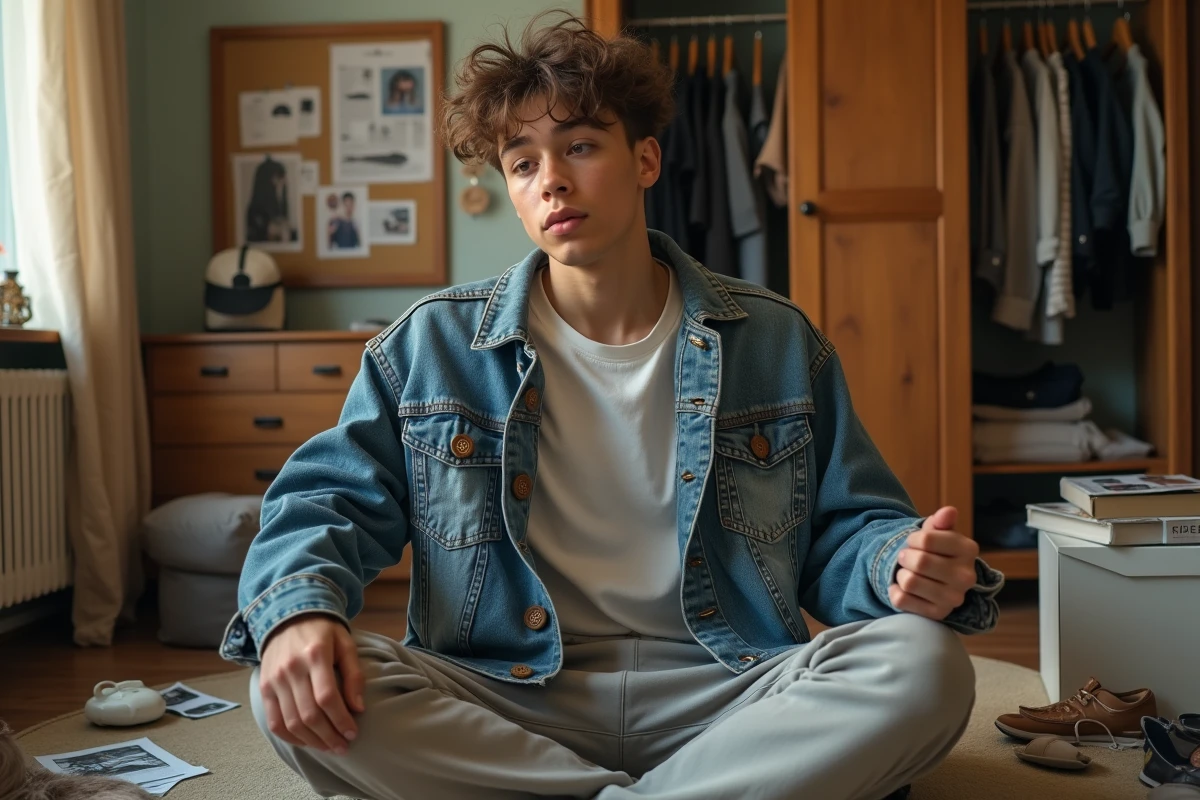
On the other hand, movements led by young people themselves are beginning to propose counter-models. Second-hand clothing is gaining ground, supported by dedicated platforms and a discourse of differentiation: not wearing what everyone else wears becomes, for a segment of this generation, an act of distinction as much as conviction.
Responsible consumption and slow fashion: where young consumers stand
Slow fashion positions itself as a structured alternative to disposable fashion. It relies on longer production cycles, sustainable materials, and transparency regarding manufacturing conditions. For young consumers, the main barrier remains price: a durable garment costs significantly more than a fast fashion equivalent.
The second-hand market is progressing as an accessible alternative for young people who wish to balance budget and commitment. This trend is gradually changing the codes: wearing second-hand clothing is no longer seen as a sign of precariousness, but as a claimed choice.
Regulation is also beginning to weigh in. Legislative initiatives aim to regulate the practices of the textile industry, particularly regarding transparency and combating overproduction. These regulatory developments could, in the long term, change the decisions of brands and, by extension, the options available to young buyers.
Fashion influences young people through a web of digital channels, social pressures, and commercial strategies that did not exist in this form a decade ago. The most powerful lever remains the mobile shopping journey integrated into social networks, which transforms every scroll into a consumption opportunity. Counter-models, led by second-hand, are progressing, but the price and visibility gap with fast fashion remains wide.