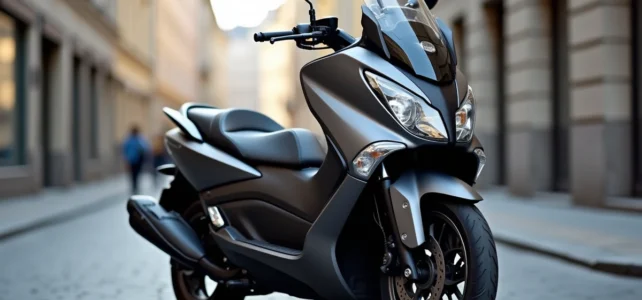
The Yamaha TMAX 750 does not exist. Yamaha is marketing a TMAX equipped with a 560 cm³ Euro5+ compliant twin-cylinder engine in 2026, not a 750 engine. The confusion likely arises from an analogy with the Honda X-ADV 750, a direct competitor in the maxi-scooter segment.
Starting from this misunderstanding allows us to refocus the question on the real issue: how much does a TMAX 560 actually cost in 2026, and at what point does its price become difficult to justify against the competition.
Read also : All the useful information about the address and hours of the CPAM in Nanterre Cedex
TMAX 560 or X-ADV 750: the price threshold where the choice tips
Comparing the TMAX 560 to the Honda X-ADV 750 is not about opposing two scooters of the same category. The X-ADV features a larger engine, a dual-clutch transmission (DCT), and all-terrain versatility that the TMAX does not aim for. Both machines share urban daily use, but their philosophies diverge as soon as you leave the city limits.
The relevant question is not which is “better,” but at what price difference one becomes more rational than the other. For exclusively urban and suburban use, the TMAX 560 retains an advantage: agility in the city, under-seat storage, manageable weight. As soon as trips lengthen or include degraded sections, the X-ADV gains the upper hand thanks to its riding position and ground clearance.
See also : Origin and manufacturing country of the Eastpak brand: what you need to know
The detailed analysis on the price of the TMAX 750 in 2026 shows that the annual ownership cost (insurance, maintenance, depreciation) weighs as much as the purchase price. The TMAX is on the list of “sensitive” vehicles with several insurers due to its high theft rate, which inflates premiums. This additional cost can reduce or even negate the catalog price difference with the X-ADV.
Finish and mileage of the TMAX 560: the two variables that set the value
In the used market, the Tech Max finish creates a notable price gap compared to the standard version. Leather upholstery, color TFT screen, smartphone connectivity, heated grips: these features justify a resale premium, provided the overall condition is good.
Mileage remains the primary factor for depreciation, but not in a linear way. A TMAX used daily for commuting accumulates kilometers quickly. Active French listings in 2026 show significant gaps between examples of the same model year, based on three criteria:
- The actual mileage and its consistency with the year of first registration. A 2023 TMAX 560 listed with very few kilometers raises as many questions as a high-mileage model.
- The documented maintenance history. Informed buyers require Yamaha service invoices, not just a stamped booklet.
- The presence or absence of original accessories (tall windscreen, Yamaha top case, engine guards). Aftermarket accessories do not enhance the vehicle’s value in the same way.
Each new generation of the TMAX accelerates the depreciation of previous models. The launch of the 25th Anniversary edition in 2026 has mechanically driven down the prices of standard 560 models from 2024-2025 on resale platforms.
The trap of personal overvaluation
Many sellers overestimate their TMAX by adding the new purchase price and the installed accessories. Aftermarket heated grips, sport exhausts, or leg shields do not resell for the price paid. The market values mechanical condition and maintenance, not the owner’s cumulative investment.
25th Anniversary Edition of the TMAX 2026: what the special series changes in pricing
Yamaha has launched a 25th Anniversary edition of the TMAX 560 to celebrate a quarter-century of production. The model boasts a heritage of 340,000 units sold since the first generation. This limited series is distinguished by a specific aesthetic inspired by the model’s history, featuring visual customization elements.
Technically, the engine block and chassis remain identical to the Tech Max version. The difference is cosmetic and commemorative, not mechanical. The additional cost compared to the standard Tech Max finish is justified only by its rarity and collector appeal.
For a buyer looking for a TMAX as a daily transport tool, the Anniversary series changes nothing in terms of use or reliability. It adds a premium at purchase that can only be recouped at resale if collector demand remains, which is uncertain for a utility vehicle.
Low emission zones and resale value of the TMAX in 2026
The ZFE restrictions in effect in major French urban areas do not yet directly affect the TMAX 560 Euro5+. However, older generations (TMAX 500 and early 530) are starting to pose problems in certain metropolises depending on their Crit’Air sticker.
This factor weighs on the used purchasing strategy. A cheap TMAX 500 or 530 could become unusable in dense urban areas within a few years, which erodes its value sharply rather than gradually. Buyers aiming for long-term urban use should prioritize 560 models that comply with the latest standards.
The used TMAX market remains very liquid in France, with active listings across several generations (500, 530, 560). This liquidity masks real disparities: demand is increasingly focused on recent 560 models, while older generations lose attractiveness as regulatory constraints become clearer.
The holding horizon changes the game. A TMAX 560 purchased in 2026 to be resold in two or three years will undergo the classic depreciation. If kept for five years or more, it could benefit from the stability of value typical of the GT maxi-scooter segment, provided Yamaha does not launch a major redesign in the meantime that would render this generation obsolete.