
Opening an Intermarché store means joining a group of independent retailers (Les Mousquetaires), in which each member holds shares in the collective structure. This participatory franchise involves a greater financial and operational commitment than a traditional franchise, but it also gives members voting rights on the network’s strategic direction.
Opening, taking over or converting a store: three scenarios to compare
The Intermarché network grows through the takeover and conversion of existing stores as well as through new openings. For a prospective member, the choice of scenario determines the budget, timeline and level of risk.
A new store opened from scratch offers complete freedom over the layout, format and location. However, there is no established customer base or sales history on which to build a reliable forecast. Construction starts from the ground up, as does recruitment.
Taking over an existing store operating under the brand means you can build on an established business, with staff already in place and measurable customer traffic. The downside is that the purchase price reflects this value, and the condition of the building may require costly upgrades to meet current standards.
Converting a competitor’s store (for example, a former Casino store) is a third option. Case studies published by Républik Retail describe temporary changes to supply areas and transfers of volumes between logistics hubs to accommodate the integration of these stores.
Before committing, consult an review of the Intermarché franchise that details on-the-ground feedback for each of these scenarios. The performance of converted stores does not guarantee the profitability of a new project: every site has its own constraints (lease, staff, business assets, construction work).

Catchment area and local competition: the analysis that determines everything
Worldpanel data reported by LSA shows that the Mousquetaires’ national growth is partly driven by its expanding store network and range of formats (stores, convenience, online). Applying this trend to a local project would be a mistake.
Competitive pressure varies considerably from one area to another. A Leclerc hypermarket three kilometers away will not have the same impact on your sales as a small Carrefour Contact. The analysis must be conducted street by street, not department by department.
Factors to assess in your catchment area study
- The resident population and transient population (business parks, roads, employment hubs) help estimate realistic customer traffic, rather than theoretical potential based on the municipality’s population.
- The number and format of direct competitors within a ten- to fifteen-minute drive: a market saturated with supermarkets may still have room for a convenience format, and vice versa.
- Local shopping habits, particularly the share of click-and-collect and home delivery, which varies considerably from one urban area to another and affects the expected sales mix.
- Access to the proposed site: parking, visibility from the road, ease of access for deliveries, and compliance with commercial planning regulations.
A forecast based on the network’s national average has no predictive value for any given site. The group provides decision-support tools, but the candidate remains responsible for the local market study.
Regulatory requirements and margin forecasts
The Egalim law regulates promotions in the food retail sector. These restrictions limit certain discounting practices (volumes, discount rates) and must be reflected in commercial forecast assumptions. Ignoring this framework would lead to overstating margins on branded food products.
Supply and logistics during the launch phase
For a new store, supply volumes ramp up in line with customer demand. In a takeover or conversion, the situation can be more complex. The Mousquetaires’ logistics network may require temporary adjustments, such as reallocating distribution centers, changing delivery routes or adapting product listings.
For prospective members, this means checking with the group on the supply arrangements specific to the proposed site, rather than relying solely on the network’s general terms. A store at the end of a delivery route will face different constraints from one located near a distribution center.
Training and joining the Mousquetaires group
The training program offered by Les Mousquetaires runs for several months. It covers store management, team leadership, use of the network’s IT systems and the specific requirements of each department (fresh, dry grocery and non-food).
Joining the group also involves acquiring shares. Candidates become co-owners of the structure, giving them access to general meetings and strategic decision-making. This model sets Intermarché apart from a traditional franchise, where the franchisee is a customer of the franchisor.
The trade-off for this shared governance is a greater financial and personal commitment. Members take part in committees and working groups, and devote time to the group’s collective operations in addition to managing their day-to-day store activities.
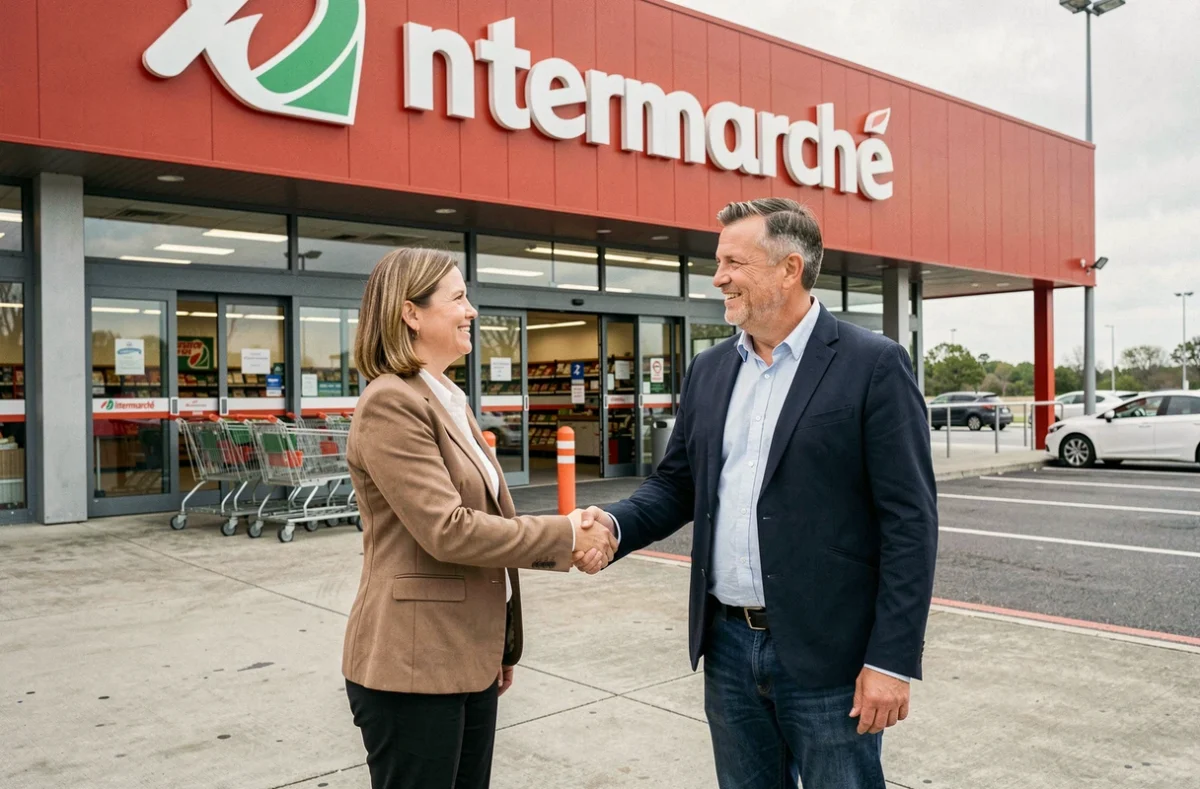
The choice between opening a new store, taking one over or converting one cannot be made using a generic checklist. It depends on available capital, the target catchment area, the condition of the building and the network’s logistical capacity at the time of the project. Candidates who devote as much time to analyzing their site as they do to reading the Pre-Contractual Information Document gain an advantage over those who rely on national averages.